PCOS & Hair Health

Your trusted source for hormones, PCOS & hair health

The Hormonal Change Happens First.The Hair Shedding Can Hit Months Later.

Woman holding a hairbrush with shed hairIllustrated hormonal symptomsWoman experiencing fatigue

Stopping birth control, changing contraception, or living with PCOS can cause hormonal shifts that affect your hair cycle and overall health.

These changes may be linked to symptoms such as:

Hair loss

Sudden or gradual shedding

Fatigue

Persistent low energy

Weight Gain

Unexplained weight changes

Dry skin

Noticeably dry or flaky

Menstrual changes

Irregular or heavier periods

Bradycardia

Unusually slow heart rate

Sensitivity to cold

Feeling cold more often

Underactive thyroid

Reduced thyroid production

Acne

Hormonal breakouts

Discover what may be happening inside your follicles, how to recognize different patterns, what to avoid, and which solutions may help your situation.

Sudden Shedding and Gradual Thinning Can Have Different Causes

Hormonal changes can affect hair in two important ways.

Sudden Shedding

A major hormonal change, such as stopping birth control, changing contraception or giving birth, can interrupt the normal hair-growth cycle. More hairs than usual may stop actively growing and enter the resting phase at around the same time. The resting phase is a phase in which hairs do not fall out immediately. They can remain attached for several months before suddenly shedding together. This can cause noticeably more hair in the shower, brush or on the pillow.

The shedding usually happens across the entire scalp instead of creating one clear bald patch. This type of delayed, widespread shedding is called telogen effluvium.

Sudden Shedding follicle illustration

Sudden Shedding

Gradual Thinning

Gradual thinning happens differently from sudden shedding. It develops slowly, often around the part and top of the head.

Women naturally have hormones called androgens, sometimes called β€œmale hormones,” even though they are present in both women and men. With PCOS, these hormone levels may be higher, or the hair follicles may be especially sensitive to them.

Sensitive follicles gradually become smaller. Each time they grow a new hair, that strand can come back thinner, shorter and weaker than the one before it. Over time, the part looks wider, the scalp becomes easier to see and the ponytail feels smaller. This process is called follicular miniaturization.

Gradual Thinning follicle illustration

gradual thinning

One woman can also experience both follicular miniaturization and telogen effluvium at the same time. That is why identifying the pattern matters before choosing a solution.

The Pill Stops Today. The Shedding May Not Start for Months.

Birth control pill illustrationCalendar showing the delayed hair cycle

Hormonal contraception can influence estrogen (female hormones), and androgen (male hormones) activity and the normal timing of the hair cycle.

After the pill is stopped or contraception is changed, the body begins adjusting to a different hormonal environment. That sudden shift can cause more follicles than usual to leave active growth and enter the resting phase. The resting phase is a phase in which the affected hairs do not immediately fall out. They can remain attached for several months before shedding together.

This delayed response can make the change feel completely unrelated. The contraception may have stopped months ago, but increased hair in the shower, a smaller ponytail or a wider part may only now be appearing.

The American Academy of Dermatology recognizes stopping birth-control pills as a potential trigger for excessive hair shedding.

Cross-section showing hair follicles beneath the scalp

What Happens Under the Scalp Before the Sudden Shedding Starts

What Happens Under the Scalp Before the Sudden Shedding Starts

First, What Is a Hair Follicle?

A hair follicle is a tiny pocket inside the scalp where each strand of hair begins. The hair visible in the mirror is only the strand. The follicle underneath the skin is the living structure responsible for producing that strand.

Think of the follicle as a tiny hair-making factory.

When the follicle is active, special cells at its base divide repeatedly and build the hair strand. As more hair is produced underneath the skin, the strand becomes longer and grows out through the scalp.

Hormonal Changes Can Tell the Follicle to Pause

Birth control affects hormones that help influence how long hair continues growing and when it begins resting.

When birth control is stopped or changed, the sudden hormonal shift may cause more follicles than usual to stop active production and enter a resting phase.

The hair does not fall out immediately.

The follicle stops adding length, becomes smaller and holds the existing strand inside the scalp. This resting strand is sometimes called a β€œclub hair” because the bottom of it becomes hard and rounded.

The Shedding Can Be Delayed for Months

A resting hair may remain inside the follicle for several months. During that time, everything can look normal even though the follicle has already stopped actively growing that strand.

When the follicle begins a new growth cycle, it starts producing another hair underneath the old one. The new hair gradually pushes the resting hair out of the scalp.

That is when the shedding becomes visible.

Why So Much Hair Can Fall at Once

Normally, follicles move through their cycles at different times. Some hairs are growing while others are resting or shedding, so daily hair fall remains less noticeable.

A major hormonal shift can cause thousands of follicles to enter the resting phase around the same time. Several months later, those follicles may also begin releasing their old hairs together.

This is why stopping birth control can appear to cause a sudden wave of shedding long after the pill was stopped.

The follicles usually have not died. They have temporarily reset their growth cycle. However, persistent shedding or progressive thinning may indicate another issue and should be evaluated by a dermatologist.

How PCOS Can Slowly Make Each New Hair Thinner

First, What Is PCOS?

PCOS stands for polycystic ovary syndrome. It is a common condition that affects how a woman’s hormones and ovaries function.

Women with PCOS may experience irregular periods, difficulty ovulating, acne, increased facial or body hair and thinning hair on the scalp. PCOS may also involve insulin resistance, which means the body has difficulty using insulin properly.

Not every woman with PCOS experiences every symptom. Someone can have PCOS without having ovarian cysts, obvious weight changes or all the usual warning signs.

First, What Is PCOS?

What Are Androgens?

Women naturally produce hormones called androgens. They are sometimes described as β€œmale hormones,” but both women and men have them.

With PCOS, the body may produce more androgens than usual.

In other cases, certain hair follicles may simply be more sensitive to the androgens already present.

This can create a confusing situation: the same hormones may increase facial or body hair while causing hair on the scalp to become progressively thinner.

What Are Androgens?

How Androgens Affect Scalp Follicles

Every hair grows from a follicle underneath the scalp.

Some follicles, especially those across the top of the head, may be genetically sensitive to androgens. When these hormones repeatedly send signals to a sensitive follicle, its active growth period can become shorter.

The follicle gradually becomes smaller and produces less hair.

The first strand may grow normally. During the next cycle, the new strand may be slightly thinner. After several more cycles, the follicle may produce hair that is shorter, finer and less visible than before.

This shrinking process is called follicular miniaturization.

How Androgens Affect Scalp Follicles

Why the Change Happens Slowly

Unlike telogen effluvium, PCOS-related pattern thinning does not usually create one sudden wave of hair falling out.

Instead, the follicles become smaller across repeated growth cycles. The change can develop so gradually that it remains unnoticed until the part looks wider or the ponytail feels significantly smaller.

Why the Change Happens Slowly

Your Hair May Be Showing Two Different Types of Warning Signs

Signs of delayed shedding:

  • A sudden increase in hair throughout the shower

  • More strands in the brush, bed or clothing

  • Diffuse volume loss across the scalp

  • Shedding that began months after a hormonal change

  • A ponytail that quickly feels smaller

Signs of progressive pattern thinning:

  • The center part gradually becomes wider

  • More scalp becomes visible across the top of the head

  • The ponytail loses thickness

  • New hairs grow back finer or shorter

  • The hair provides less coverage than before

  • Familiar hairstyles become harder to create

  • Volumizing products stop producing the same result

Most Hair Products Only Change What You Can See

The hair visible in the mirror is the strand. The follicle is the tiny living structure underneath the scalp that produces that strand.

Shampoos, conditioners, masks and styling serums mainly work on the visible hair. They can make it feel softer, look shinier and temporarily appear thicker, but that does not mean the follicle underneath has changed.

Three strands showing temporary coating effects

They Create a Temporary Coating

Conditioners, masks and styling serums leave a thin conditioning layer over the hair shaft.

This coating can smooth the rough outer surface, reduce frizz, fill damaged areas and make each strand reflect more light. As a result, the hair may immediately look healthier, thicker and more polished. But the effect is temporary.

As the hair is washed again, much of that protective coating is removed. The strands can return to looking dry, flat or thin because the product changed their surface, not how they were being produced inside the scalp.

Shampoo Is Designed to Wash Away

Shampoo removes oil, sweat, dirt and product buildup. It performs an important cleansing job, but it remains on the scalp for only a short period before being rinsed away.

Ordinary shampoo is not designed to stay around the roots for hours. It cannot rebalance hormones, treat PCOS or change the instructions that hormones are sending to sensitive follicles.

Hair Masks Usually Never Reach the Scalp

Most masks and conditioners are applied from the middle of the hair to the ends. Applying them directly to the scalp may leave the roots heavy, greasy or coated with buildup.

That means the ingredients are concentrated on the existing strands, not delivered as focused, leave-in scalp care.

Styling Serums Can Create the Illusion of Density

Many hair serums coat individual strands, making them look smoother and slightly thicker.

This can temporarily disguise a wider part or reduced volume. Once the coating is washed away, however, the same thinning pattern becomes visible again.

Making an existing strand look thicker is not the same as helping the follicle produce a healthier-looking strand.

Hormonal Hair Changes Begin Under the Scalp

Hormonal shedding and follicular miniaturization begin inside the follicle, below the visible surface.

Illustrated follicle below the scalp

A temporary coating on the lengths cannot:

  • Rebalance hormones after stopping birth control
  • Reduce androgen activity associated with PCOS
  • Restart a resting follicle
  • Reverse progressive follicular miniaturization
  • Correct an iron, thyroid or nutritional problem
  • Permanently stop hormonally triggered shedding

Shampoo, conditioner and masks still matter for cleansing and protecting the existing hair. But a complete routine also needs focused care applied directly to the scalp and roots, where the hair-growth process begins.

There Is No Single Treatment for Every Hormonal Hair Change

Minoxidil

Topical minoxidil was made for female pattern hair loss and can help some women maintain or regrow hair.

However, it is not an instant solution. A temporary increase in shedding may occur during the first two to eight weeks, and treatment generally requires six to twelve months before its effectiveness can be judged.Β 

If it works, continued daily use is required to maintain its benefits. When treatment stops, the supported hair will gradually be lost again.

Scalp follicles and topical dropper illustration

Looking Beyond Minoxidil: The Most Credible Botanical Ingredients We Found

Follicles with botanical ingredients

Once we understood that hair growth begins inside the scalp, the next question was simple: which ingredients actually deserve to be in a scalp serum?

We did not want ingredients chosen because they were trending, sounded natural or looked impressive on a label. We looked for published research examining hair counts, cultured human follicles, dermal papilla cells, follicle-cycle activity and normal hair biology.

The evidence was equally strong for every ingredient..

We reviewed published research involving scalp health, human follicles, follicle-cycle activity and hair counts. Four ingredients stood out as relevant to a scalp-focused cosmetic routine.

Four Focused Ingredients in One Root-First Routine

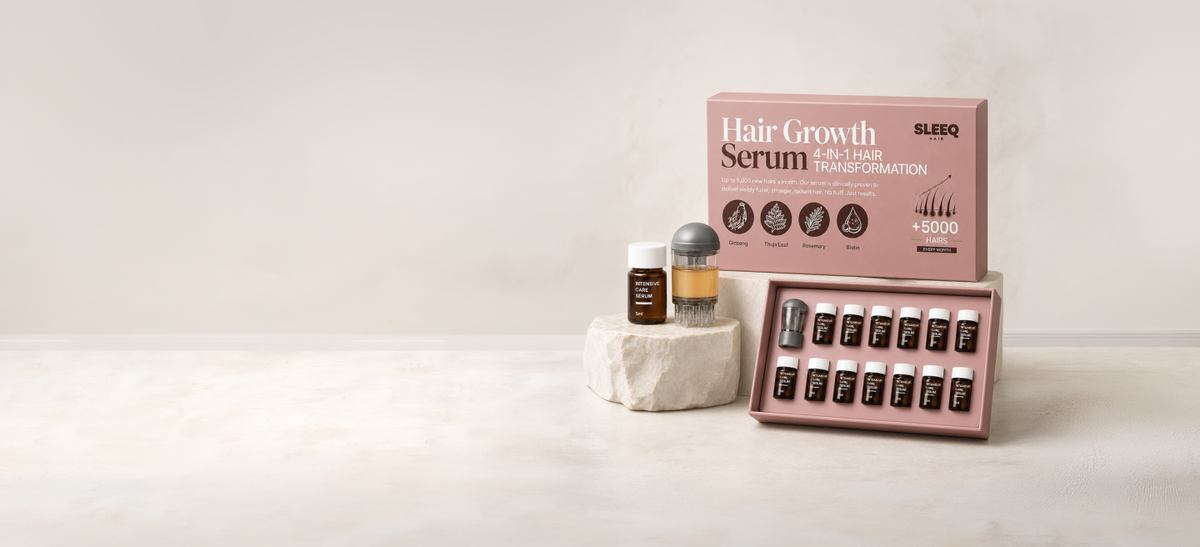
After comparing scalp serums, SLEEQ Hair Growth Serum 4-in-1 stood out because it combines:

Scalp circulation

Rosemary

In a six-month randomized trial involving 100 participants with hair loss, rosemary oil was compared with 2% minoxidil. Both groups experienced a significant increase in hair count after six months.

Root vitality

Korean Red Ginseng

Laboratory research found that red ginseng extract increased hair-shaft elongation in cultured human follicles and supported the activity of dermal papilla cells involved in regulating the hair cycle.

Growth support

Thuja Leaf

In a human study, topical Thuja orientalis extract moved resting follicles into active growth earlier and increased follicle number and size.

Strand strength

Biotin

Biotin is essential for normal cellular metabolism, and deficiency can cause thinning hair. Its supported cosmetic role is helping promote the appearance of thicker, fuller-looking hair.

SLEEQ scalp serum vial and roller applicator

It is designed to support visibly fuller-looking hair, healthier-looking roots and reduced breakage without leaving the scalp oily or sticky.

The precision roller applicator helps distribute a light layer directly across the hairline, part and desired scalp areas instead of coating the lengths.

It does not claim to correct hormonal imbalance or replace medical treatment.

It provides the supportive scalp-care step that many routines overlook.

DISCOVER SLEEQ HAIR GROWTH SERUM

They Stopped Treating Only the Hair and Started Caring for the Scalp

From sudden shedding after stopping birth control to gradual thinning associated with PCOS and other hormonal changes, these women noticed that their usual shampoos, masks and styling products were no longer enough.

Customer hair photoCustomer hair photo

β˜…β˜…β˜…β˜…β˜…

β€œPCOS made my hair noticeably thinner. I tried countless shampoos, but nothing seemed to help. My hair finally feels healthier and more manageable.”

Sarah, 35

Verified customer

Customer hair photoCustomer hair photo

β˜…β˜…β˜…β˜…β˜…

β€œMy hair started thinning when my hormones were out of balance. I tried everything, but shampoo wasn’t enough. I needed something that supported my scalp from within.”

Sarah, 35

Verified customer

Customer before and after comparison

β˜…β˜…β˜…β˜…β˜…

β€œAfter stopping birth control, my shedding suddenly increased. My hair felt so much thinner, and I knew I needed to try something new. I wanted to support my hair growth.”

Emily, 31

Verified customer

Customer hair photoCustomer hair photo

β˜…β˜…β˜…β˜…β˜…

β€œI’ve struggled with hair thinning because of PCOS. Seeing my part get wider was incredibly frustrating. I wanted something that focused on my scalp.”

Amanda, 41

Verified customer

Customer hair photo

β˜…β˜…β˜…β˜…β˜…

β€œMy hair started feeling thinner during hormonal changes. No matter how many hair products I tried, I couldn’t get my hair back to normal.”

Lauren, 35

Verified customer

Customer before and after comparison

β˜…β˜…β˜…β˜…β˜…

β€œI didn’t realize how much my hormones were affecting my hair until the shedding started. My usual hair routine just wasn’t cutting it anymore.”

Rachel, 39

Verified customer

They added SLEEQ Hair Growth Serum 4-in-1 to their routines and began applying focused care directly to the scalp and roots.

Their timelines and experiences are different, but each story begins with the same realization: healthy-looking hair requires more than temporarily coating the visible strands.

SLEEQ Hair Growth Serum box, vials and applicator

Hormones Can Disrupt the Hair Cycle. Scalp Care Is the Essential Step You need to Fight Back

Begin by understanding the pattern, investigating persistent changes and choosing the right product to fight hair loss and shedding.

Give the roots the same attention already being given to the visible strands.

START YOUR SLEEQ SCALP-CARE ROUTINE

Lightweight. Non-oily. Non-sticky. No rinse. 13 Vials + Applicator in 1 box